There are places in this world that whisper. There are places that shout. And then there is Borobudur — which does neither. It just sits there, calmly, like it has seen everything and decided most of it was not worth reacting to.
Located in Magelang, Central Java, Borobudur is often introduced as “the largest Buddhist temple in the world.” Which sounds impressive, until you realize the temple itself has never introduced itself that way. Humans did. We love superlatives. Largest. Oldest. Tallest. As if history were a competitive sport.
Borobudur was built in the 8th and 9th centuries during the Syailendra dynasty. That means while Europe was busy figuring out feudalism and questionable fashion choices, Java was building a massive stone mandala in the shape of a cosmic diagram. No big deal.
Planning unforgettable yogyakarta tours? Before you scroll past another itinerary, imagine starting your journey at Borobudur with stories that actually make you think. That’s where yogyakartatour.com comes in—crafting experiences, not just schedules. Because in Yogyakarta, you don’t just visit temples. You walk into conversations with history.
A Temple That Is Actually a Journey
Borobudur is not just a building. It’s a process. You don’t just “enter” Borobudur; you ascend it. You walk in circles. You go up level by level. It’s basically the original stairmaster, but with enlightenment at the end instead of leg cramps.
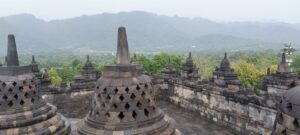
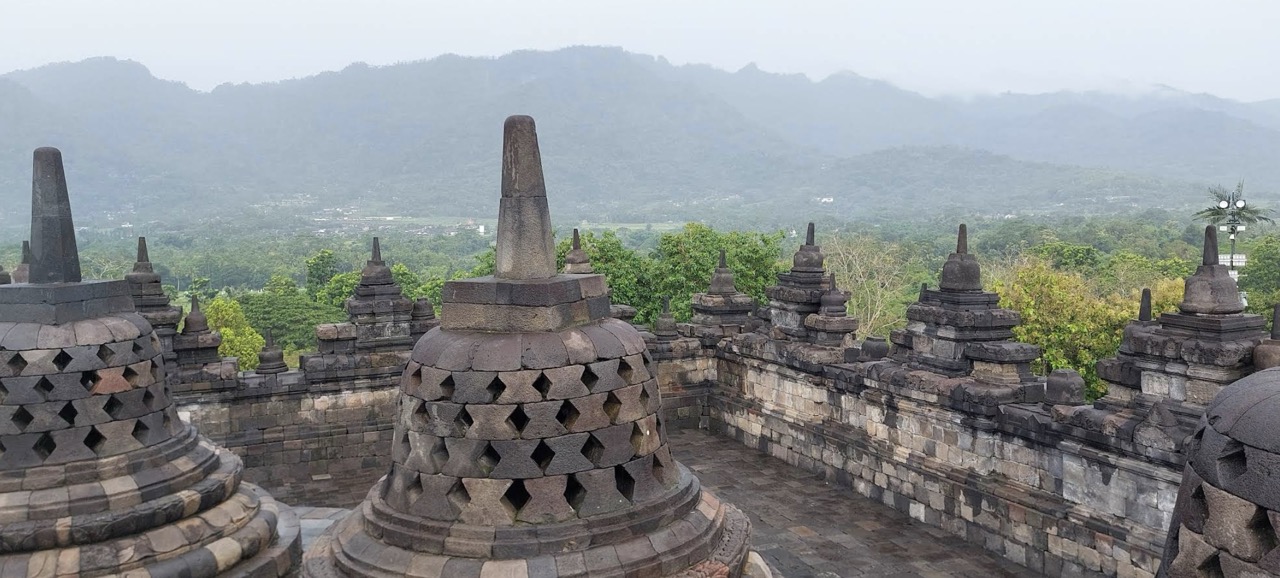
The structure consists of nine stacked platforms — six square and three circular — topped by a large central dome. Around it are 72 perforated stupas, each containing a statue of Buddha. Seventy-two. Because apparently 71 wasn’t symmetrical enough.
But here’s the beautiful part: Borobudur is designed as a three-dimensional representation of Buddhist cosmology.
- Kamadhatu – the world of desire
- Rupadhatu – the world of forms
- Arupadhatu – the formless world
In other words, Borobudur is a giant stone TED Talk about human existence.
You start at the bottom, surrounded by relief panels depicting human desires, temptations, consequences. Basically, ancient Instagram but carved in volcanic rock. Then you move upward, and the carvings become simpler. The space opens. The walls disappear. By the time you reach the top, it’s just open sky and quiet stupas.
It’s architecture as philosophy.
And honestly, that’s very Javanese. Instead of arguing loudly about enlightenment, they built it.
The Relief Panels: Netflix Before Electricity
Borobudur contains over 2,600 relief panels and 500 Buddha statues. That’s not decoration. That’s commitment.
The panels tell stories from Buddhist texts — including the Lalitavistara (the life of the Buddha) and Jataka tales (stories of the Buddha’s previous lives). Each carving is detailed, expressive, almost cinematic. If you walk slowly and actually look, you realize this was once a narrative experience.
Imagine being a pilgrim in the 9th century. No podcasts. No Spotify. No “Skip Intro” button. You walk clockwise, reading the stone like chapters in a book. Each level is a lesson. Each step is symbolic.
And now? Most tourists take three selfies, say “Wow, sunrise is nice,” and go home.
Which is fine. We are modern. We have schedules.
Lost and Found: The Temple That Took a Nap
Here’s a fun historical twist: Borobudur was abandoned.
At some point — possibly around the 14th century — it was covered by volcanic ash and jungle growth. The center of Buddhist life shifted elsewhere, Islam became more dominant in Java, and Borobudur quietly disappeared from global attention.
It didn’t complain. It just waited.
In 1814, during British rule in Java, Sir Thomas Stamford Raffles (yes, the same guy associated with Singapore) heard rumors of a massive monument hidden in the jungle. Excavation began. Slowly, Borobudur re-emerged.
Imagine being a temple, buried for centuries, and then suddenly tourists show up with cameras.
That’s resilience.
Sunrise: The Ritual of Waking Up Early
If you mention Borobudur, someone will say, “You have to see it at sunrise.”
Which is true. And slightly cruel.
Because to catch the sunrise, you must wake up before the sun. Which feels unfair. But when you stand at the top level and watch the sky shift from indigo to gold, something changes.
The mist floats over the Kedu Plain. Mount Merapi looms in the distance. The stupas become silhouettes. The air is cool and quiet.
And for a moment — a rare, fragile moment — everyone stops talking.
Borobudur at sunrise is not dramatic. It’s gentle. It doesn’t scream for your attention. It allows you to notice.
Which is different.
also read How to Go to Borobudur Temple Start From Bali
A Mandala You Can Walk Inside
From above, Borobudur looks like a giant mandala — a sacred geometric diagram representing the universe in Buddhist cosmology. Symmetrical. Balanced. Intentional.
But here’s the part I find fascinating: you don’t understand the mandala by looking at it from a drone. You understand it by walking it.
Modern life encourages overview. We love the aerial shot. The summary. The headline.
Borobudur says, “No. Walk.”
Walk the desires. Walk the stories. Walk the silence. Walk the emptiness.
And maybe — just maybe — understand something about yourself.
Stones That Outlived Empires
Empires rise. Empires fall. Dynasties argue. Politicians debate. Hashtags trend.
Borobudur remains.
It survived volcanic eruptions. Earthquakes. Colonialism. Neglect. Tourism. And probably people carving their initials where they shouldn’t.
In the 20th century, a massive restoration project supported by UNESCO helped preserve the temple. Today, it stands not only as a place of pilgrimage but also as a UNESCO World Heritage Site.
But beyond titles and protection statuses, Borobudur represents something deeply Indonesian: quiet endurance.
Not loud. Not flashy.
Just steady.
Visiting Borobudur Today
If you visit today, you’ll see a mix of pilgrims, students, foreign travelers, and local families. Some come for spiritual reasons. Some come for historical curiosity. Some come because it’s on the itinerary.
And that’s okay.
Borobudur does not demand purity of intention. It has existed too long to be insecure.
You’ll probably notice:
- The symmetry of the upper terraces
- The perforated stupas shaped like stone lace
- The Buddha statues with serene expressions
- The relief carvings, still sharp after more than a millennium
You may also notice something else — a certain stillness. Even when crowded, there is a strange calmness to the structure. As if the geometry itself absorbs chaos.
Why Borobudur Still Matters
In a world that values speed, Borobudur values process.
In a world that values noise, Borobudur values silence.
In a world obsessed with instant results, Borobudur says, “Climb.”
And maybe that’s why it continues to matter.
Not just as a monument. Not just as a tourist destination. But as a reminder that enlightenment — whatever that means to you — is not an elevator.
It’s a staircase.
A circular one.
With 2,600 stone panels reminding you that humans have always struggled with desire, ego, confusion, and hope.
We are not as modern as we think.
Final Thoughts from a Pile of Stones
Borobudur does not sell itself aggressively. It doesn’t have neon lights. It doesn’t need a rebrand. It doesn’t update its interface.
It simply exists.
And in existing, it teaches.
That perhaps the most powerful statements are not shouted.
They are carved.
So the next time you stand among the stupas of Borobudur, don’t rush. Don’t just photograph. Don’t just post.
Walk.
Because somewhere between the first step and the highest terrace, between desire and formlessness, between noise and silence — you might discover that the temple was never just about Buddha statues or ancient dynasties.
It was about you.
And that realization, unlike sunrise, does not require waking up early.
It only requires paying attention.