There are temples that feel like museums. You walk in, you look around, you nod politely at history, and you leave with a souvenir magnet.
And then there is Prambanan.
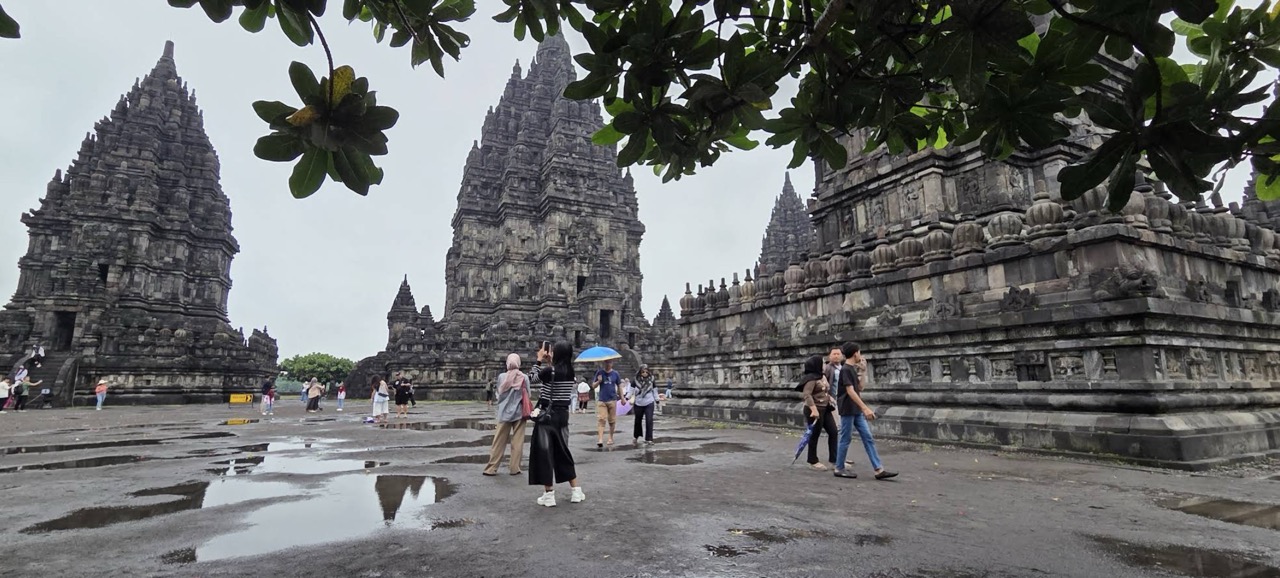
Prambanan doesn’t feel like a museum. It feels like a statement. A very tall, very symmetrical, very confident statement carved in stone sometime in the 9th century — when people apparently had the energy to build 47-meter towers without complaining about back pain.
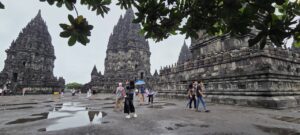
Located near Yogyakarta, Prambanan is the largest Hindu temple complex in Indonesia. Which already sounds dramatic. But the temple itself doesn’t try to impress you with numbers. It impresses you with posture.
It stands upright. Sharp. Vertical. Like it is still reaching for the sky.
Looking for meaningful yogyakarta tours that go beyond ordinary sightseeing? Start your journey with yogyakartatour.com, where every itinerary is crafted with story, depth, and perspective. Because visiting Prambanan isn’t just about taking photos — it’s about understanding why these towering stones still reach confidently toward the sky.
The Architecture of Ambition
If Borobudur is about walking inward, Prambanan is about looking upward.
The central complex consists of three main temples dedicated to the Trimurti: Shiva, Vishnu, and Brahma. The tallest and most dominant is the Shiva temple — because even in ancient architecture, there was always a main character.
The Shiva temple rises about 47 meters high. Which in the 9th century was basically the architectural equivalent of saying, “We are not here to play small.”
The design follows classical Hindu cosmology. The temple is divided into three vertical zones:
- Bhurloka – the world of mortals
- Bhuvarloka – the world of saints and ascetics
- Svarloka – the realm of the gods
In other words, Prambanan is a spiritual elevator. Except there’s no elevator. Just stairs. Always stairs.
Built by a Kingdom with Confidence
Prambanan was built during the reign of the Sanjaya dynasty of the Mataram Kingdom. Historians believe construction began around 850 CE. That’s over a thousand years ago. Which means this temple has outlived empires, fashion trends, and several definitions of what “viral” means.
And yet, like many great things in history, it was not immune to disaster.
Earthquakes damaged it. Political shifts weakened the kingdom. The site was eventually abandoned and partially collapsed. Nature did what nature does — it reclaimed.
But Prambanan didn’t disappear forever. Restoration efforts in the 20th century slowly brought it back. Stone by stone. Like assembling a 1,200-year-old puzzle without the original instruction manual.
There is something poetic about that. Humans build. Humans forget. Humans rebuild.
The stones stay patient.
The Ramayana in Stone
Walk along the inner balustrade of the Shiva and Brahma temples, and you’ll find relief panels telling the epic story of the Ramayana.
Yes, before streaming platforms, before cinema, before spoiler alerts — there were walls.
The story of Rama, Sita, Lakshmana, and Hanuman unfolds panel by panel. Demons. Devotion. Loyalty. War. Love. Betrayal. It’s all there, carved with astonishing detail.
If you walk clockwise — as tradition suggests — you follow the narrative in order. It’s like binge-watching an ancient series, except the buffering time is however fast you can walk.
And here’s the interesting part: the Ramayana story is Indian in origin, yet here it is, immortalized in Central Java. That tells you something about how cultures travel. Not through conquest alone, but through exchange.
Prambanan is proof that Indonesia has always been connected to a wider world.
The Legend of Love and Stone
Of course, no ancient temple in Java would be complete without a love story. Enter the legend of Roro Jonggrang.
According to folklore, a prince named Bandung Bondowoso fell in love with Princess Roro Jonggrang after defeating her father in battle. She did not return the affection — which is already a strong foundation for conflict.
To avoid marrying him, she gave him an impossible condition: build one thousand temples in a single night.
The prince, being magically assisted, almost succeeded. So the princess tricked him by making villagers light fires and pound rice to simulate dawn. Thinking morning had come, the spirits stopped building. The temple count stopped at 999.
Furious, the prince cursed the princess, turning her into stone — the thousandth statue.
Romantic? Not exactly.
But the statue of Durga inside the Shiva temple is often associated with Roro Jonggrang. Visitors still come, touch the stone, and whisper wishes about love.
Because humans never change. We will turn even a curse into a romantic ritual.
Prambanan at Dusk: When Stone Softens
Visit Prambanan in the late afternoon, and something subtle happens.
The sharp lines of the temple begin to soften under golden light. The sky shifts color. The shadows grow longer. And the entire complex feels less like a monument and more like a memory.
Unlike Borobudur’s rounded calmness, Prambanan’s silhouette is dramatic. Pointed towers rise like stone flames. The symmetry becomes more pronounced against the fading sky.
It’s the kind of view that makes people suddenly quiet — not because a sign says “Please be silent,” but because the scale demands humility.
And maybe that’s the point.
Earthquakes and Endurance
Indonesia sits on the Ring of Fire. Which is a poetic name for “geologically unstable.”
Prambanan has endured multiple earthquakes, including a significant one in 2006 that caused further damage. Some parts of the complex remain under restoration even today.
But there is something strangely reassuring about that.
The temple is not frozen in time. It is in conversation with time.
Every crack tells a story. Every restored block is an act of care. Every scaffold is a reminder that preservation is not automatic — it is intentional.
We don’t inherit heritage. We maintain it.
A Stage for Stories
In modern times, Prambanan is not just a historical site. It is also a cultural stage.
The Ramayana Ballet is performed regularly in an open-air theater near the temple complex. Imagine watching dancers reenact the same epic story carved into the walls — with the illuminated temple as a backdrop.
That’s not just performance. That’s continuity.
Stone tells the story. Humans retell it. Generations reinterpret it.
Culture is not static. It echoes.
Why Prambanan Still Matters
It would be easy to reduce Prambanan to a tourist checklist item.
“Largest Hindu temple in Indonesia.”
“Built in the 9th century.”
“UNESCO World Heritage Site.”
Facts are convenient. They fit neatly into brochures.
But Prambanan is more than its data points.
It is a reminder that Indonesia’s identity has always been layered. Hindu, Buddhist, Islamic, colonial, modern — not in competition, but in sequence.
The temple stands as evidence that faith once soared vertically here. That stories crossed oceans. That architecture was once theology in stone form.
And perhaps most importantly, it reminds us that beauty can survive interruption.
Climbing Without Climbing
Unlike Borobudur, you don’t physically ascend Prambanan in a spiral journey. The experience is more observational. You stand before it. You circle it. You look up.
It invites contemplation from below.
Which feels appropriate.
Because sometimes growth is not about climbing higher. Sometimes it is about recognizing something higher than yourself.
A Final Look Upward
If you stand in the central courtyard and tilt your head back, the towering spires of Prambanan frame the sky like a carefully designed illusion.
Clouds move. Birds pass. Light shifts.
The temple remains.
And in that stillness, you might feel something unexpected — not necessarily religious, not necessarily mystical — but reflective.
A sense that humans, even centuries ago, longed for transcendence.
That we carved our hopes into stone.
That we reached upward, not because we were certain, but because we were searching.
Prambanan is not just a temple complex in Yogyakarta.
It is a question mark made of rock.
And perhaps that is why it continues to stand — tall, sharp, unapologetically vertical — asking every visitor the same silent question:
What are you reaching for?