There are two types of travel experiences.
The first type: you arrive, you walk around, you take photos, you leave.
The second type: you sign a waiver.
Goa Jomblang or jomblang cave belongs to the second category.
Located in Gunungkidul, Yogyakarta, Goa Jomblang is not a cave you casually “visit.” It is a cave you descend into — vertically — like you are reconsidering your life choices one meter at a time.
And honestly, that’s part of the charm.
A Hole in the Earth, Politely Waiting
From above, Goa Jomblang looks like a sinkhole. Which, technically, it is. A massive vertical shaft formed thousands of years ago when the ground collapsed, creating a 60-meter-deep entrance into the earth.
It’s the kind of geological event that sounds dramatic — but the cave itself feels calm.
Nature doesn’t rush its artistry. It erodes patiently. It collapses selectively. It builds ecosystems in places humans would never think to decorate.
And then we show up with helmets and harnesses.
The Descent: Gravity Becomes Personal
The adventure begins with a controlled rope descent into the cave. You’re strapped into safety gear, briefed by professional guides, and then — slowly — lowered down the vertical wall.
This is the moment when gravity becomes personal.
At the top, everything feels normal. There are trees. There is sunlight. There are other visitors pretending not to be nervous.
Halfway down, you realize two things:
- The earth is deeper than you thought.
- Your trust in strangers with ropes is stronger than you expected.
But as your feet touch the bottom, something shifts. The noise from above fades. The air becomes cooler. The light changes.
You are no longer just a tourist.
You are underground.
An Underground Forest That Forgot the Sky
At the bottom of the vertical shaft lies something unexpected: a lush, green, almost prehistoric-looking forest growing inside the cave.
Because when the ceiling collapsed centuries ago, sunlight found a way in. And where there is sunlight, there is life.
Trees stretch upward from the cave floor. Moss clings to damp rocks. Ferns flourish in filtered light. It feels like stepping into a lost world — the kind usually reserved for big-budget adventure films.
Except this one is real.
The silence here is different. It’s not empty. It’s thick. You can hear water droplets echoing. You can hear your own footsteps. You can hear your thoughts — which is both poetic and slightly uncomfortable.
The “Light of Heaven” Moment
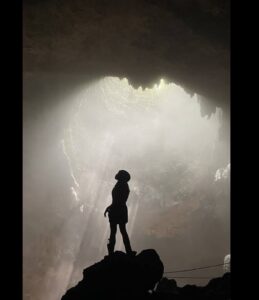
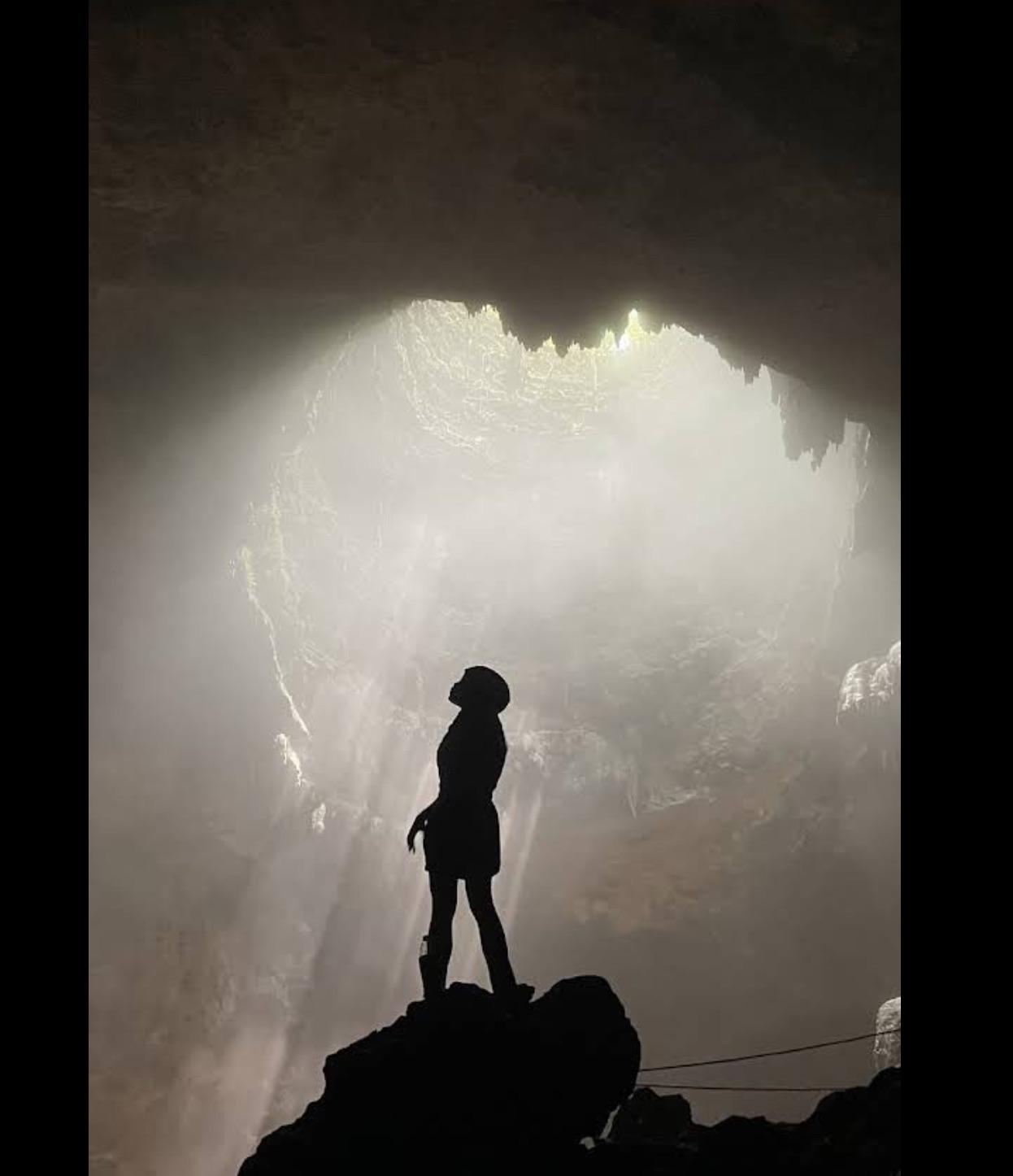
If you time your visit correctly — typically late morning to early afternoon — you’ll witness what locals and guides call the “Light of Heaven.”
A single, dramatic beam of sunlight pierces through the vertical opening above, illuminating the cave floor in a spotlight of golden brilliance.
It’s theatrical. Almost suspiciously perfect.
Dust particles dance in the beam. The surrounding darkness contrasts sharply with the glowing column of light. For a few minutes, the cave transforms into something sacred.
And you don’t need to be religious to feel it.
Because light entering darkness is universally symbolic. It doesn’t matter what belief system you subscribe to — when sunlight finds its way into a hidden cavern, it feels meaningful.
And maybe that’s the point.
Walking Through the Tunnel of Reflection
After exploring the underground forest, visitors continue through a muddy tunnel that leads deeper into the cave system, eventually connecting to Grubug Cave.
The tunnel is narrow. The ground is slippery. The walls are textured with mineral formations shaped by centuries of dripping water.
It’s not glamorous. There are no marble floors. No decorative lighting. No souvenir shops.
Just rock. Water. Earth.
And strangely, that simplicity feels refreshing.
In a world obsessed with curated experiences, Goa Jomblang offers something raw. Something unedited.
You will get dirty. Your shoes will not remain pristine. Your hair will not cooperate.
And yet, you will probably smile.
Formed by Time, Not Trend
Geologically, Goa Jomblang is part of the karst landscape of Gunungkidul, a region famous for limestone formations shaped over millions of years.
Karst terrain is created when soluble rocks dissolve over time, forming sinkholes, caves, and underground rivers. It’s a slow, patient process.
Which is ironic, because most of us experience it in under three hours.
There is something humbling about standing inside a cave formed over millions of years and thinking, “I have a meeting tomorrow.”
Perspective arrives quietly underground.
Adventure with Responsibility
Caving in Goa Jomblang is guided and regulated. This is not a place to test your DIY survival instincts.
The guides are trained. The equipment is standardized. Safety protocols are strict. And that’s reassuring — because nature does not negotiate.
But there’s also an environmental responsibility here. The ecosystem inside the cave is delicate. The forest exists because of a specific balance of light, moisture, and airflow.
One careless action can disrupt something that took centuries to stabilize.
Adventure is exciting. But preservation is essential.
The Psychology of Going Down
Most travel destinations elevate you — mountains, towers, temples. Goa Jomblang does the opposite.
It takes you down.
And maybe that’s why it feels different.
There’s a subtle metaphor in descending into the earth to find light. We often associate growth with upward movement. Promotions. Achievements. Rankings.
But sometimes clarity comes from going inward. Or downward.
When you stand at the cave floor, looking up at a circular opening framed by jagged rock, you see the sky differently. It becomes a distant, precious thing.
You realize how much you take it for granted.
And for a moment, you appreciate the simple luxury of open air.
Mud, Laughter, and Shared Experience
Goa Jomblang is rarely experienced alone. You descend in small groups. You walk through mud together. You laugh when someone slips. You help each other across narrow paths.
There is camaraderie in mild discomfort.
Strangers become temporary teammates. Shared adrenaline breaks social barriers. And by the time you ascend back to the surface — pulled upward by ropes — you feel oddly connected to people whose last names you don’t know.
Maybe that’s another gift of the cave.
It reminds you that humans cooperate better when slightly out of their comfort zone.
Returning to the Surface
The ascent is slower than you expect. Gravity resists your upward journey more than it assisted your descent.
But when you finally reach the top and step back onto solid ground, sunlight feels different. Brighter. Warmer. Earned.
You look at the sinkhole again — this massive vertical entrance into darkness — and it no longer feels intimidating.
It feels like a story you carry.
Goa Jomblang is not about conquering nature. It’s about participating in it.
It’s about trusting ropes. Embracing mud. Waiting for light.
And maybe understanding that some of the most beautiful experiences require you to step into uncertainty — safely, responsibly, but courageously.
A Final Thought from Underground
Travel often promises escape. Goa Jomblang offers exposure — to nature, to vulnerability, to perspective.
It doesn’t overwhelm you with grandeur. It doesn’t compete with skyscrapers or temples.
It simply opens a hole in the earth and says, “Come down.”
And when you do, you discover that light is more dramatic in darkness. That silence is louder underground. That adventure doesn’t always mean speed — sometimes it means stillness beneath stone.
So if you ever find yourself in Yogyakarta tours, considering whether to descend into a cave carved by time itself, remember this:
The earth has been waiting longer than you have.
And sometimes, the most enlightening journeys begin by going down.